Controller Area Network (ISO 11989-1)
It is a multidroo serial bus providing physical and data link layer specifications for connecting mutiple participant nodes. On physical layer it uses diffrenrtial electical signal.
Key features
- Excellent noise immunity
- Multi master
- Priority based messageing
- Error checking
- Industrial standard with many suppliers
- Data rate from 5Kb/s to 1Mb/s
- Cable length from 40m (1Mb/s) to 1000m (40Kb/s)
- Multidrop with maximum 127 nodes
- Asynchronus transmission
Singal logic levels
It uses Non return to zero NRX coding.
- Recessive Logic 1
- Dominant Logic 0
Bit stuffing
Due to NRZ method a proper continours signal of transmitting same bit may cuase recever to think its in error stage. Hence bit stuffing method is used.
Sender send complement value if it detects five bits with same value to be transmitted Receiver will also discard the stuff bit value.
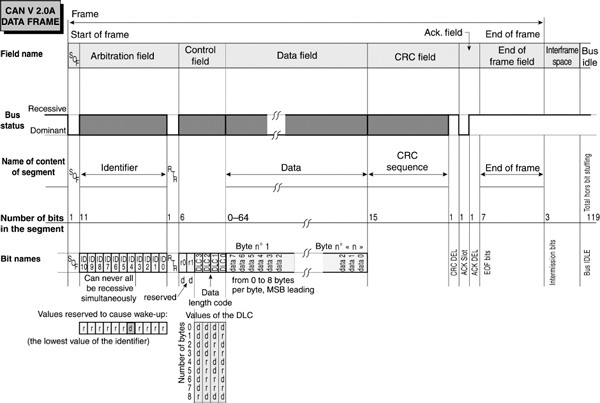
Data frame
Remote frame
Overload frame
Error frame
Communication Protocol
Access to bus is by using carrier sense multiple access with collision detection called bitwise arbitration. Bus normally remain in recessive state. To transmit node first checks for inactivity and sends a frame to bus. For simulatanious transmission node with lower arbitration value take the bus. Other nodes stops till other high priority nodes complete the transmission.
As CAN only provide details about physical and data link layer remaianing top layers was not standardize in earlier versions. This caused complatibilities issues with diffrent vendores.
Various top level 3 to 7 standars are
CANopen
Used for industrial machien control, medical, railways.
DeviceNet
Used as fieldbus for factory automation. Maximum 64 nodes can be used till maximum 500 Kb/s.
J1939
This is used in heavy trucks and buses. It uses 29 bit identifier.
Error Handling
A bus error of message can occure because of either transmittor or receciver. CAN uses unique method of error detection using positive and negative acknowlegment method. All stations on bus receives all the messages and every node will try to acknowldge message in perticular time slot (ACK). If message is received and positively acknowldged by at least one station. It indicates that message is transmitted correctly. If negative acknowlegment is received and not a single positive acknowlegment is received means it is the fault of messages transmittor.